
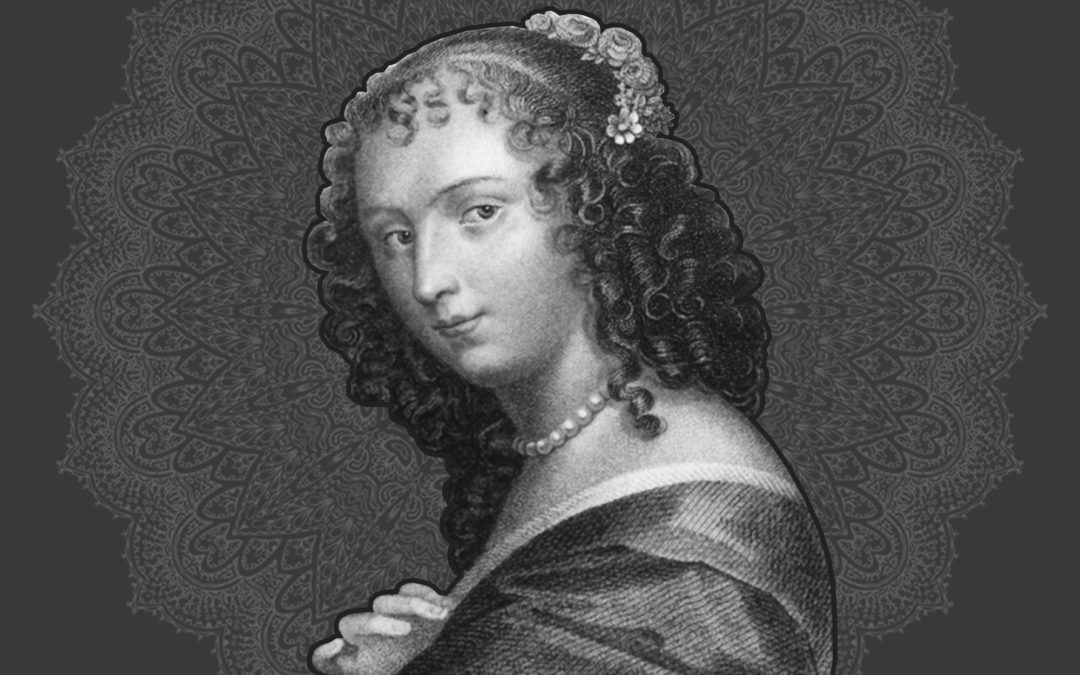
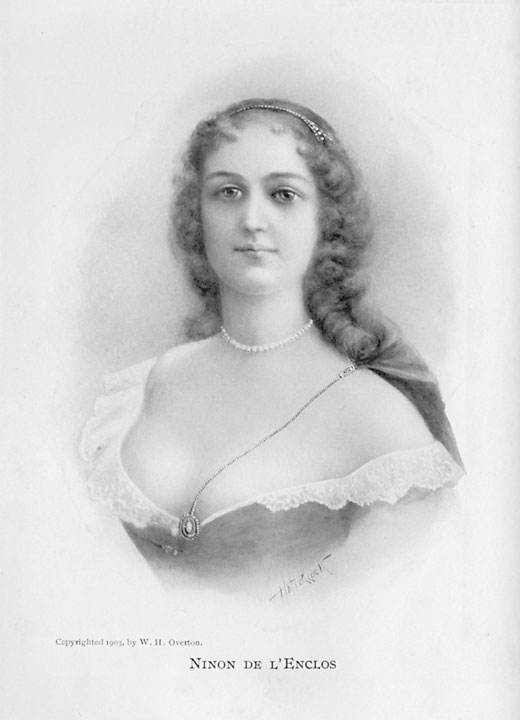
It is Ninon de Lenclos letter writer and French woman of letters, author of Letters from Ninon de Lenclos to the Marquis de Sévigné.
Queen of the Parisian salons, this courtesan was famous for her independent spirit and her great generosity. It shone in Le Marais with its famous “five to nine” where the Parisian intellectual elite flocked every day.
It was her father Henri de Lenclos, a libertine and cultured gentleman from Tours who gave her, against the advice of her mother, a complete education, far from that provided to girls of the time. At the age of twelve, Ninon lost this loyal support. Compromised in an affair of adultery followed by a duel in which his opponent was killed, his father had to flee. Dueling being prohibited, the king seized his property.
From then on Ninon accompanied her mother to the salons of the Marais, where she quickly caused a sensation. A true child prodigy, she cited the great authors and mastered the thought of Montaigne as much as she excelled in playing the lute or harpsichord and spoke Italian and Spanish. Literature, dance, the arts and sciences had no secrets for her.
Her white complexion, her deep black eyes, her gestures, her voluptuousness were praised but it was her spirit that was most celebrated.
At sixteen, her mother, although bigoted, guided her towards “gallantry” and left her free to live in Le Marais, near the Place royale, now Place des Vosges.
Later, she settled inin the Hôtel de Sagonne located at 36, rue des Tournelles, where she lived for forty-eight years. Dn this modest mansion in the Marais, which still exists today, this independent spirit became the darling of the Marais and Paris in holding the most fashionable literary salon of its time where from five o'clock until nine but sometimes ten o'clock in the evening, people flocked some of the finest minds of her time: Madame de Sévigné, Madame de Maintenon, Molière, François de la Rochefoucault, Corneille, Saint-Simon, Jean-Baptiste Lully, Charles Perrault, Jean Racine, Jean de la Fontaine, Paul Scarron , Nicolas Boileau, etc.
In addition to being an “influencer” Ninon de Lenclos symbolized the freedom of morals current in the XNUMXth and XNUMXth centuries. Reputed to be a friend as faithful and devoted as an inconstant and frivolous mistress, she had many lovers including the great Condé (general, first cousin of Louis XIV and peer of France), the soldier and diplomat Marshal d'Estrées, the the astronomer Christian Huygens, the diplomat and literary abbot of Chateauneuf, Nicolas Gédoyn, canon of Sainte-Chapelle and member of the French academy…
She died in 1705 in this same residence.
Text: Katia Barillot
28.01.19
FOR PASSIONATES OFUS
Victor Hugo, the writer with a thousand talents
Born in 1802, Victor Hugo became a social writer, a playwright, a poet, a novelist and a romantic designer. Nicknamed the man-ocean then the man-century, he is a political figure and a committed intellectual. He found success with Notre-Dame-de-Paris in 1831 and with Les Misérables in 1862.
Juliette Drouet actress, muse and mistress of Victor Hugo
At 14 rue Sainte-Anastase, from 1836 to 45 and at 12 from 1845 to 48, a few hundred meters from Place des Vosges, lived the muse and lover of Victor Hugo, Juliette Drouet née Julienne Gauvain.
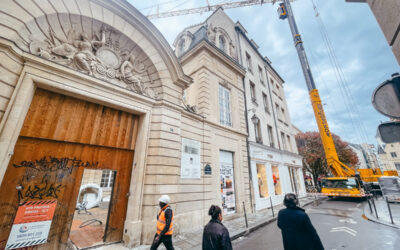
Rue Vieille-du-Temple: the fabulous construction site restarts
A luxury hotel will be created at the end of the work. On the ground floor, the old stables and carriage houses will house the restaurant on the large courtyard, while the first courtyard, on rue Vieille-du-Temple, will feature two businesses continuing its 19th century layout.
NOW ON THE MOOD MARSH
Victor Hugo, the writer with a thousand talents
Born in 1802, Victor Hugo became a social writer, a playwright, a poet, a novelist and a romantic designer. Nicknamed the man-ocean then the man-century, he is a political figure and a committed intellectual. He found success with Notre-Dame-de-Paris in 1831 and with Les Misérables in 1862.

The best tattoo parlors in Marais
Tattooing, an age-old practice, has long been the prerogative of convicts, dock workers, the underworld and sailors. Although it has become democratized, now affecting all profiles and concerning one in five French people, including 16% women compared to 10% men, it still remains taboo due to its definitive and transgressive nature.
Juliette Drouet actress, muse and mistress of Victor Hugo
At 14 rue Sainte-Anastase, from 1836 to 45 and at 12 from 1845 to 48, a few hundred meters from Place des Vosges, lived the muse and lover of Victor Hugo, Juliette Drouet née Julienne Gauvain.